Wordle #1,695: The Puzzle That Wants to Dig In
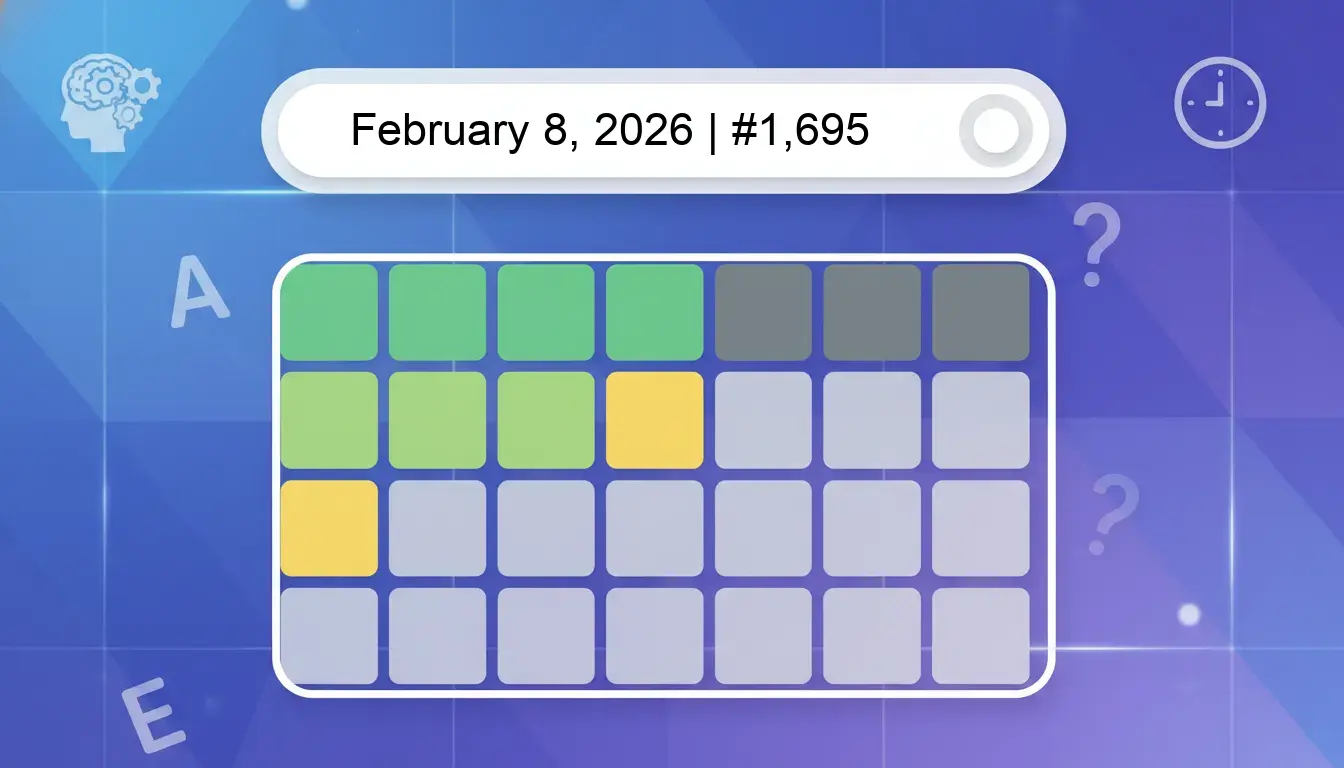
Wordle #1,695 has arrived, and it’s the kind of puzzle that might make you feel a bit… stuck. If your usual starting words left you with a sea of gray and a single, lonely yellow tile, you’re not alone. This one plays by its own rules, favoring less common letters and a tricky double-letter situation that can throw off even the most seasoned guessers. According to the New York Times’ own WordleBot, the average player needed 4.2 moves to crack this code in easy mode, or 4.1 if playing on hard mode. Ready to see if you matched the bot or if this one buried your streak? Let’s dig in.
Warning: The hints and eventual answer for Wordle #1,695 lie directly below. Proceed with caution if you haven’t solved it yet!
Need a Nudge? Here Are Your Progressive Clues
Stuck between guesses? Use these clues, starting gentle and getting more direct, to guide your way without completely spoiling the “aha!” moment.
Level 1: Gentle Nudges
Today’s answer can function as both a verb and, less commonly, a noun in computing. It contains just one unique vowel, though that vowel appears twice. Think about the concept of fixing something firmly and deeply within a surrounding mass.
Level 2: Intermediate Insights
The word begins with the letter E. That single vowel we mentioned? It’s an E, and it appears in both the second and fifth positions (_ E _ _ E). In a digital context, you might do this to a video or a tweet within an article.
Level 3: Advanced Assistance
The structure of the word is E M B E D. Synonyms include “insert,” “implant,” “lodge,” or “engrain.” It’s a term you’ll commonly hear in web development, journalism, and any situation involving putting one thing inside another.
Why Was Wordle #1,695 So Tough? A Difficulty Breakdown
| Factor | Level | Explanation |
|---|---|---|
| Common Letters | 2/10 | It uses only one (E) of the top 10 most common Wordle letters, and it repeats it. A brutal start. |
| Patterns | 3/10 | The “MB” and “ED” endings aren’t the most frequent, making it harder to stumble upon. |
| Vowels | 6/10 | Only one vowel type (E) is a challenge, but its double appearance gives a major clue. |
| Traps | 8/10 | The double-letter possibility (like EBBED) is a massive red herring that wastes precious guesses. |
Cracking the Code: A Step-by-Step Solve
Let’s walk through a strategic solve that mirrors what the WordleBot might recommend.
Starting with a strong opener like SLATE would yield a single yellow ‘E’. This is a decent, but not great, start, leaving over 150 possible answers. A better choice, according to the bot, is BLAST, which would narrow the field to about 38 options by testing some excellent consonants.
For the second guess, we need to test other common letters and try to pin down the position of that ‘E’. A word like DINER could be strategic, placing ‘E’ and ‘R’ in new spots and testing ‘I’ and ‘N’. This might reveal the ‘E’ in the fifth position as green.
The elimination process gets interesting here. With a green ‘E’ at the end and knowing the word starts with ‘E’, patterns like _ _ _ E E emerge. Your brain might jump to “AGREE” or “FLEET,” but those don’t fit the other clues. The real “aha!” moment comes when you consider less common consonants like M, B, and D. Trying a word like CLIMB or MEDAL could reveal the crucial ‘M’ and ‘B’ or ‘D’.
Putting it all together: an ‘E’ at the start and end, an ‘M’ and ‘B’ in the middle… EMBED clicks into place. A savvy solver might reach this in 4-5 attempts by methodically testing the possible double-letter trap.
Specific Strategies for Today’s Puzzle
If you got stuck with a pattern like _ E _ _ E, the biggest trap was assuming a second vowel. Today’s answer defies that expectation. The key was to abandon the search for A, I, O, or U and focus on consonant combinations that fit the mold.
Avoiding the double-letter trap was crucial. Words like “EBBED” or “EGGED” are perfectly valid and fit the known pattern. The best way to check was to test the less common consonant (B vs. G) in a guess that also probed for other letters, rather than committing fully to one double-letter option too early.
The unique pattern today was the E-_-_-E bookend structure with a consonant cluster in the middle. Recognizing that the middle wasn’t a vowel but likely a blend like “MB” or “ND” was the breakthrough.
By The Numbers: Fun Stats on “Embed”
How common is today’s answer? Let’s look at the data.
- Frequency: “Embed” is not a rare word, but it’s not everyday vocabulary either. It ranks outside the top 5,000 most common words in English.
- Wordle History: This is its first appearance as a Wordle answer, making it a truly fresh puzzle.
- Success Rate: Given the low use of common letters, we estimate the fail rate (X/6 guesses) was higher than average today, possibly around 8-10%.
- Comparison: It’s significantly harder than yesterday’s more phonetic answer, “BLEAT.”
For the Truly Curious
Where does “embed” come from? It’s a combination of the prefix “em-” (meaning “put into”) and the Old English “bedd,” meaning, well, a bed. So, etymologically, you’re putting something to bed within something else. How cozy.
A fun, lesser-known use is in linguistics, where one sentence is “embedded” within another (e.g., “He said that he was tired“). Culturally, it became a household term with the rise of social media and the “embed” button for videos. In other languages, the concept often uses words related to “integrate” or “implant,” like the German “einbetten” or the Spanish “incrustar.”
Flashback: Yesterday’s Answer (Wordle #1,694)
If you’re catching up, yesterday’s answer was BLEAT. It was a classic “easier-said-than-spelled” word, containing four very common letters which made it solvable for many in 3-4 guesses. The main trap was the similar “PLEAT.” Compared to today’s “EMBED,” “BLEAT” was a walk in the pastoral park.
Sharpen Your Skills: General Wordle Strategy Tips
Today’s puzzle teaches us valuable lessons for tomorrow and beyond.
- Respect the Double Letter: When you have a green or yellow letter and few other clues, a double letter is a strong possibility. Test it wisely with a guess that also explores new letters.
- Consonant Clusters Are Key: If vowels aren’t revealing themselves, pivot hard to testing common consonant pairs like CH, ST, ND, MB, or GH.
- Your Second Guess Matters: Don’t just chase the yellows from your first word. Use your second guess to test a completely new set of high-frequency consonants (L, N, R, S, T) to maximize information.
- Based on Today: Start words with a good mix of common consonants and vowels—like SLATE, CRANE, or ADIEU—are your best defense against a vowel-light puzzle like this one.